Aesthetics software
Aesthetics software, built for the whole clinic.
One platform for bookings, deposits, consent forms and patient records, built specifically for aesthetics clinics. Not a salon tool bent to fit, and not fifty modules you will never open: the four things a clinic actually runs on, done properly.
- £25 per practitioner, unlimited everything. The whole platform on one plan, no tiers.
- 0% commission to us. Deposits land in your own Stripe, not ours.
- Built for the coming licensing standards. Versioned consent, batch numbers, full audit trail.
No charge today. 14-day trial, set up in minutes.
Software for aesthetic clinics, and the people who run them.
AesthetiClinic is clinic management software for non-surgical aesthetics: the bookings, consent, clinical notes, records, compliance evidence and follow-up that keep a clinic full, coming back and able to show its work. Built hands-on with a working clinic, for the way practitioners actually work, at the chair, on a phone, with record-keeping that stands up to the strictest regulators.
One platform, one price, one client file. The sections below cover each job in turn: the diary, consent, clinical notes, the patient record, compliance and licensing readiness, marketing and rebooking, and what changes when a solo practitioner takes on a second pair of hands.
Solo aesthetic practitioners
Nurses, prescribers and aesthetic practitioners running single-room clinics who want bookings, consent and records in one place without paying for seats they do not need.
Growing multi-room clinics
Clinics with several practitioners and rooms that need shift-aware availability, role-based access and an audit trail across the whole team.
Clinics leaving legacy software
Practices on Aesthetidocs, Faces, Aesthetic Nurse Software, paper or spreadsheets who want a modern system without losing their patient records in the move.
Booking and deposits
A booking page that fills your diary and takes the deposit.
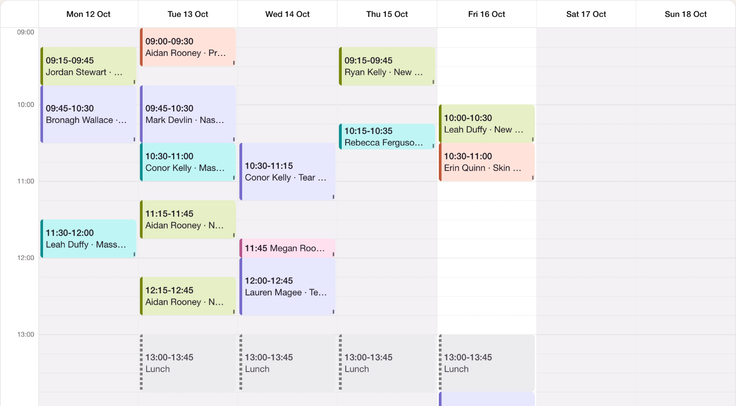
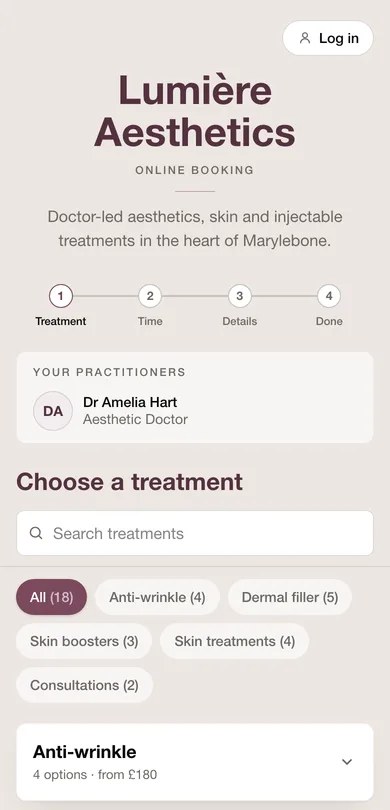
A booking page under your own brand and domain, showing real availability from your practitioners' shifts. Patients pick a slot, pay the deposit you require, and land in the diary with double-booking protection enforced at the database, not just the screen.
- Deposits through your own Stripe account: 0% commission to us, settles to you
- Your cancellation and reschedule rules, enforced automatically
- Practitioner shifts, time off and multi-room support
- Email reminders included; SMS as prepaid message bundles, so there is never a surprise bill
- Waitlist capture for full days
Does it run a whole clinic, or just one diary?
Most clinics run on a stitched-together set of tools: a booking app, a forms app, records somewhere else, and a separate bill for each. The gaps between them are where time and records get lost. AesthetiClinic keeps the diary, the client file, consent, payments and reporting in one place, so one £25 price replaces three or four subscriptions and the people running the clinic spend less time reconciling tools.
Each practitioner has their own shifts, time off and one-off overrides. The diary enforces them with double-booking protection at the database, not a visual warning anyone can click past. Role-based access means reception runs the diary without seeing medical histories, prescribers and practitioners see their patients, and the owner sees everything with a full audit trail behind it.
Multi-practitioner, multi-room, multi-location. Shift-aware availability across the whole team, rooms and sites.
Roles for owners, prescribers, practitioners and reception. Each sees what their job needs, nothing more.
Reporting built in. A monthly validation report names the records that are incomplete, so a gap is found before an inspector finds it.
One-click full export, any time. No notice period, no exit fee, standard formats.
Setting up rather than switching? See the guide to how to open an aesthetics clinic, or the booking system in detail.
Consent and forms
Digital consent that stands up: e-signed, versioned, attached to the patient.
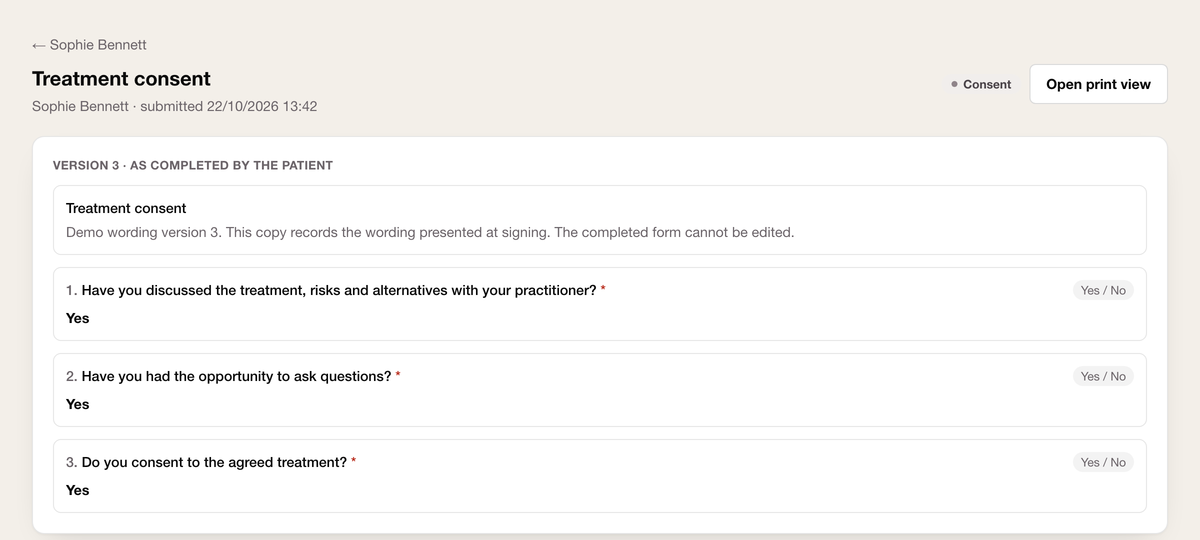
Medical histories, treatment consents and aftercare acknowledgements, sent to the patient's phone before the appointment or completed at the chair. Signatures are drawn, timestamped and locked to the form version that was signed.
- Patients complete forms on their own phone: no app, no account, a secure tokenised link
- Treatment-specific templates you can edit to match your practice
- Form versioning: you always know which wording each patient signed
- Works logged-out at the chair when the wifi or the front desk is busy
- Completed forms write back to the patient record instantly
What do clinical notes look like on the treatment record?
The practitioner writes the note on the record itself, next to the client's photos, signed consent and treatment history, so the note and the record it belongs to never separate. If you currently scribble on paper between appointments, or type the note up later from memory, the template does the boilerplate at the chair and you record only what was different about this client, this visit.
Your standard note, pre-filled
Save your usual note structure once, general or tied to a specific treatment, and every new record starts from it. Notes stay consistent across the team without anyone holding the house style in their head, and everything stays editable.
Product, dose, batch and site are fields, not prose
The details an inspector or an insurer asks for are captured as structured fields: product, quantity, unit, batch number, expiry, instrument and injection site. Match a product to your stock list and the quantity used deducts automatically, so the note and the stock position agree without double entry. The free-text narrative sits alongside for everything else.
Injection mapping, point by point
Each record can carry an injection map: tap each point on the face map and record the product, dose, batch and depth against it. A review appointment, or a colleague picking the client up, reads the actual placement rather than a reconstruction of it.
Notes are held on UK-controlled infrastructure, encrypted at rest and in transit, with role-based access and GDPR-compliant processing throughout. Complete, audited notes are part of keeping licensing-ready records, and consent can be signed at the chair when the front desk is busy. Notes, templates and mapping are included in the one price, not an add-on.
Records, photos and audit
Clinical records built for the 2026 licensing era.
England's licensing scheme for non-surgical cosmetic procedures is expected to make record-keeping standards a condition of trading. AesthetiClinic records are structured for the standards it is expected to set: per-treatment notes with product batch numbers, consented photography, and an audit trail on every record.
- Treatment lines with product, batch number and dose
- Before and after photos captured from the phone, stored against the patient
- Patient alerts for allergies, contraindications and notes for the team
- Every view and edit logged: who, what, when
- Role-based access for practitioners, front desk and owners
Is this electronic patient records software, or something lighter?
"Electronic patient records" usually means a hospital or GP system, built around clinical coding, referrals and letters. AesthetiClinic is electronic patient records software for the aesthetics clinic instead. Each client's record is structured around what a non-surgical practice actually documents: treatment lines with product and batch number, consented before and after photos, e-signed consent and a full audit trail, all held electronically on one file rather than in a paper folder or a phone camera roll. It replaces the paper record without asking you to learn a system designed for a different kind of medicine.
Photos are captured from the phone or tablet at the chair and saved straight to the client record with consent flags, so the images and the treatment notes live together. Client alerts flag allergies, contraindications and notes for the team on the file itself. Because the record is electronic and audited from the first line, it is also structured for the record-keeping the coming licensing standards are expected to require: see the licensing-ready records checklist it is built around.
Records sit on UK-controlled infrastructure, encrypted at rest and in transit, with GDPR-compliant processing throughout. If you ever leave, clients, consent, photos, notes and bookings export in one click, in standard formats, with no request queue and no exit fee. We built export in because most clinic software traps your records.
How does it help with compliance and licensing readiness?
The rules around non-surgical cosmetic treatments are tightening. The under-18 ban and the face-to-face prescribing rules are already law across the UK, and licensing schemes are coming. AesthetiClinic gives you the systems to evidence good practice and get ready. It does not make your clinic compliant on its own, we will not claim it does, and nothing here is legal advice.
Already law, UK-wide
It is an offence to arrange or perform botulinum toxin or filler treatments for cosmetic purposes on under-18s under the Botulinum Toxin and Cosmetic Fillers (Children) Act 2021. The healthcare regulators' ban on remote prescribing of injectable cosmetic medicines has applied since 1 June 2025.
Scotland, from 6 September 2027
Scotland's legislation on non-surgical cosmetic procedures is law, with its main provisions due to come into force on 6 September 2027: premises registered with Healthcare Improvement Scotland, criminal offences for breaches, and treating under-18s a criminal matter.
England, coming
A licensing scheme for non-surgical cosmetic procedures in England is planned but has slipped. The commitment is to introduce it within this Parliament rather than to a firm date, so there is time to prepare, not a reason to panic.
Read more on each: England's 2026 licensing scheme, the JCCP register, CQC registration for aesthetics, and the licensing-ready records checklist.
Age verification
Under-18s blocked before they can book or pay.
Treatments you mark as age-restricted ask for a date of birth at the point of online booking and block under-18s before any payment is taken, so an under-age booking never reaches your diary. The same block is enforced in the staff diary and through the public booking API, and under-25s are flagged for a Challenge 25 ID check in clinic. It is built around the Botulinum Toxin and Cosmetic Fillers (Children) Act 2021, under which booking an under-18 is itself an offence and the statutory defence is having effective systems in place.
- Date of birth required on age-restricted treatments, under-18s blocked before payment
- Challenge 25: under-25s flagged for an ID check at the chair
- The same block enforced in online booking, the staff diary and the public API
- An ID-check record on the patient file: document type, who checked, and when
- A named GMC-registered doctor can record an override for the Act's medical-need exception
Credentials, kit and prescribing
The evidence an inspector asks for, already on file.
A credential vault holds professional registrations such as NMC, GMC, JCCP and Save Face, indemnity insurance, DBS checks, training certificates and licences, per practitioner and at clinic level, each with an expiry date and an automatic reminder email before it lapses. An emergency-kit register records the complication drugs you hold, for example hyaluronidase and adrenaline, with batch number, expiry, who authorised supply and where each is kept. And the prescriptions module records the prescriber's registration number and a face-to-face consultation attestation before a prescription is approved.
- Credential vault: registrations, insurance, DBS, training and licences, with expiry reminders. Owner-only
- Emergency-kit register, ready to show an inspector or insurer on request
- Face-to-face prescribing evidence, aligned to the remote-prescribing ban in force since 1 June 2025
- Treatments can name a supervising regulated professional
- Every record fenced to your clinic by row-level security, denied by default
Keeping registrations and cover current is part of licensing readiness. See the guides to aesthetics insurance and safe sharps disposal, or how we protect clinical data. AesthetiClinic helps you show your work; it does not certify your clinic, replace professional judgement, or constitute legal advice.
What marketing does it do between appointments?
Rebooking is won in the days after the appointment, when you are at your busiest. You did not train for years to spend your evenings writing reminder texts, so the marketing layer runs while you are at the chair. It is included in the one £25 price, and every send is gated on the patient's own marketing opt-in, with a tokenised unsubscribe link on every message and a per-message log so nobody is ever double-sent.
Keep them coming back
Confirmations, reminders, aftercare and a 48-hour check-in send themselves. Recall fires at each treatment's own interval, lapsed clients are nudged around the three-month mark, and abandoned bookings get one tap back into the checkout they left. Reminders and aftercare also help reduce no-shows, and a built-in waitlist fills the slots cancellations free up.
Fill a quiet week on purpose
Pick a segment, write the message, send: lapsed clients, everyone who had a particular treatment, birthdays this month. Pair it with a promo code scoped to chosen treatments, a gift voucher, or a patient-bound offer that cannot be screenshotted and shared. Recurring memberships and prepaid packages are sold and redeemed from the patient record.
Grow your reputation, and answer the replies
About three days after a completed appointment, opted-in patients are asked how it went, and happy reviewers are guided straight on to your Google review link. When a patient texts back, the reply lands in a threaded inbox, so the front desk can answer without handing out a personal mobile number. STOP and START opt-outs are handled automatically.
Conversion, measured
And the booking page gets better while you sleep.
Marketing that brings people to a leaky booking page is money down the drain. Your funnel is measured end to end on your real bookings, the dashboard names your biggest leak in plain English, and we refine the booking flow continuously across the whole platform, so every clinic's conversion keeps improving without anyone becoming a CRO expert.
- Landed, treatment view, details, booked, confirmed: every step measured
- Built-in A/B testing, run for you, reported per variant
- A monthly validation report on the records side: what is incomplete, and where
- No Google Analytics, no cookie banner, no data leaving the clinic
Booking funnel
Distinct visitors at each step
10.6%
Conversion rate
30
Bookings confirmed
282
Visitors
Landed
282 (100% of landed)
Treatment viewed
166 (59% of landed)
116 dropped off here — biggest leak
Details viewed
107 (38% of landed)
59 dropped off here
Booking submitted
69 (24% of landed)
38 dropped off here
Booking confirmed
30 (11% of landed)
39 dropped off here
Every message, on brand
The polished follow-through, without you writing it each time.
Every automated message is yours to reword so it sounds like your clinic rather than a system, and each send is logged once on the patient file. Email reminders, confirmations and aftercare are free and unlimited. SMS is a flat 7p plus VAT a message, bought as 1,000-message bundles inside the platform, so there is never a surprise bill.
- Every automated message editable in your own words
- Email confirmations, reminders and aftercare free and unlimited
- SMS at 7p plus VAT, prepaid in bundles, no surprise bill
- Optional Mailchimp sync if you already run your audience there
Lumière Aesthetics
Aftercare · sent automatically
Hi Olivia, thank you for visiting today. For the next 24 hours please avoid heat, exercise and make-up over the area, and stay upright for four hours. Any questions, just reply here.
We’d love a quick review if you have a moment, it genuinely helps the clinic. Thank you for choosing us.
Delivered · recorded on Olivia’s file
Does it suit a solo aesthetic nurse, or only a full team?
Both, and there is no per-seat penalty while it is just you: a solo practitioner pays the same flat £25 plus VAT per practitioner as a multi-room clinic, with no minimum team size. The best-known UK tools in this category, Aesthetic Nurse Software (ANS) among them, grew up around the solo aesthetic nurse: one practitioner, one diary, one set of records. They do that job well.
The question changes when the clinic changes. A second injector, a prescriber who visits on Thursdays, or a receptionist who needs the diary but not the medical histories: that is the point software designed around one practitioner starts to need workarounds, and the point AesthetiClinic was built for. If you expect to stay a single practitioner for the foreseeable future, a long-established solo-first tool may well be the better fit, and the multi-practitioner features we lead with would sit unused. A switch you regret helps nobody, so we say so plainly on the comparison page.
One platform, one price, nothing held back.
Every capability on this page is included in the one £25 plus VAT per practitioner price: the diary, consent, notes, records, compliance tools and the marketing engine. No tiers, no usage caps, no booking fees, and deposits through your own Stripe at 0% commission to us.
Aesthetic clinic software, made for UK clinics and built to the latest guidelines.
Generic salon and medical systems were not designed around UK aesthetics. AesthetiClinic is. Patient data sits on UK-controlled infrastructure, encrypted at rest and in transit, with GDPR-compliant processing and role-based access throughout. Consent, batch numbers and the audit trail are built for the record-keeping standards the coming licensing scheme is expected to require, so you are ready before it is law. See what England's 2026 licensing scheme is expected to require, the licensing-ready records checklist we built around it, and what voluntary registration on the JCCP register does and does not signal.
Already on another system? We run the migration with you, record by record. We tell you exactly what gets out of Aesthetidocs, Faces, Aesthetic Nurse Software, Pabau, paper or spreadsheets before you spend a penny, migrate it for you, and you confirm everything before going live.
Aesthetic clinic software questions, answered straight
What is aesthetic clinic software?
Aesthetic clinic software is the management system a non-surgical cosmetic clinic runs on: online booking and deposits, digital consent forms, clinical patient records, and the reminders and aftercare that keep clients coming back. AesthetiClinic brings all four into one platform built specifically for UK aesthetics practitioners, rather than a generic salon or medical tool bent to fit.
What makes the best aesthetic clinic software for a UK clinic?
For a UK aesthetics clinic the things that matter most are record-keeping that is built for the coming licensing standards, consent that is versioned and e-signed, deposits that settle to you at 0% commission to us, and the freedom to export your data whenever you want. AesthetiClinic is designed around exactly those four, with a single flat price and no per-practitioner seats.
Is this aesthetic clinic management software suitable for solo practitioners?
Yes. There are no per-seat charges and no minimum team size, so a solo practitioner pays the same flat monthly price as a multi-room clinic. The booking page, consent forms, records and reminders all work from a phone at the chair, which suits a mobile or single-room practice.
Does it manage more than one practitioner and room?
Yes. Each practitioner has their own shifts, time off and one-off overrides, the diary enforces them with double-booking protection at the database rather than a warning anyone can click past, and role-based access lets reception manage the diary without seeing medical histories. Multiple rooms and locations are supported.
Which aesthetic clinic software has built-in reporting features?
Reporting is built into AesthetiClinic rather than bolted on. A monthly validation report shows where records are incomplete: which appointments are missing signed consent, notes or photos. The booking funnel is measured end to end on your real bookings, with the dashboard naming your biggest drop-off in plain English, and built-in A/B tests are reported per variant. None of it needs Google Analytics, a cookie banner or data leaving the clinic.
What do clinical notes look like on a treatment record?
The practitioner writes the treatment note on the record itself, alongside the client's photos, signed consent and treatment history. You can save your standard note structure as a template, general or tied to a specific treatment, so a new record pre-fills and you edit only what changed. Product, quantity, unit, batch number, expiry, instrument and injection site are structured fields rather than free text, and a product matched to your stock list deducts automatically.
Can I chart injection points on a face map?
Yes. Each treatment record can carry an injection map: tap each point and record the product, dose, batch and depth against it, so the placement detail lives with the note rather than in a separate diagram.
Is this electronic patient records (EPR) software?
Yes, in the sense that matters to an aesthetics clinic: it holds each client's patient record electronically instead of on paper, with treatment history, e-signed consent, before and after photos and a full audit trail on one secure file. It is electronic patient records software built specifically for non-surgical aesthetics, not a hospital or GP EPR bent to fit, so the record is structured around treatments, product batch numbers and consented photography rather than generic clinical coding and referrals.
Does AesthetiClinic make my clinic compliant with the new licensing rules?
No software can do that on its own, and we will not claim it does. What AesthetiClinic gives you is the systems to evidence good practice and prepare: age-verification checks at the point of booking, a credential and insurance vault, an emergency-kit register, face-to-face prescribing evidence, and versioned e-signed consent with a full audit trail. Responsibility for meeting your legal and regulatory obligations stays with your clinic, and nothing here is legal advice.
How does the age-verification check work?
Treatments you mark as age-restricted ask for a date of birth at the point of online booking and block under-18s before any payment is taken, so an under-age booking never reaches your diary. The same block is enforced in the staff diary and through the public booking API, and under-25s are flagged for a Challenge 25 ID check in clinic. An ID-check record sits on the patient file with the document type, who checked it and when, and a named GMC-registered doctor can record an override for the Act's medical-need exception.
Can I keep my team's registrations and insurance in one place?
Yes. The credential vault stores professional registrations such as NMC, GMC, JCCP and Save Face, indemnity insurance, DBS checks, training certificates and licences, per practitioner and at clinic level. Each item carries its expiry date and the system emails a reminder before it lapses, so a registration never quietly runs out. The vault is owner-only.
Is AesthetiClinic ready for England's 2026 licensing scheme?
The record-keeping is built for it: versioned consent forms with e-signatures, treatment notes with product batch numbers, consented photographic records, and a full audit trail of who changed what and when. As the 2026 licensing scheme details are finalised we track them and update the templates. That is preparation, not a guarantee of compliance, and it is not legal advice.
What marketing does AesthetiClinic actually do for a clinic?
Three layers. An always-on lifecycle engine sends reminders, aftercare, recall and review requests automatically. A campaign tool lets you send one-off email or SMS broadcasts to segments you choose, such as lapsed clients or everyone who had a particular treatment. And the booking page itself is measured end to end, with built-in A/B testing, so the conversion side improves without you touching it. Every send is gated on the patient's own marketing opt-in.
How do the SMS campaigns and reminders get charged?
SMS is a flat 7p plus VAT per message, bought as 1,000-message bundles inside the platform, so there is never a surprise bill. Automatic emails such as confirmations, reminders and aftercare are free and unlimited, and marketing campaigns include 500 emails a month, with prepaid credits at £5 plus VAT per 1,000 beyond that.
Is AesthetiClinic an alternative to Aesthetic Nurse Software (ANS)?
Yes. Aesthetic Nurse Software is one of the best-known UK tools and it is popular with solo practitioners. AesthetiClinic is built for multi-practitioner clinics from day one: shift-aware diaries, role-based access and a clinic-wide audit trail. If you expect to stay a single practitioner for the foreseeable future, a long-established solo-first tool may well be the better fit, and we say so plainly on the comparison page.
How does switching from other aesthetic clinic software work?
We run the migration with you rather than leaving you an import button. We map what your current system will hand over, migrate it, seed your consent templates, and you confirm everything looks right before going live. The switching page breaks down what gets out of Aesthetidocs, Faces, Aesthetic Nurse Software, Pabau, paper or spreadsheets, system by system.
Can I get my data out if I leave?
Yes, completely and at any time: patients, consent records, photos, notes and bookings in standard formats, one click, no notice period, no exit fee. We built the exit door in because lock-in is the disease in this market.
See your clinic running on it, this week.
Start a free 14-day trial and set it up on your own treatments and forms. Prefer a guided tour first? Book a 20-minute demo and we will walk you through it on your clinic, not a canned version.
No charge today. One-click export if you ever leave.